
Heritage Conservation in Urban India
| Company | Role | Tools Used | Outcome |
| Institute of Social and Economic Change – Center for Urban Affairs | Lead Researcher | Policy Analysis Literature Review | 2 Reports |
Project Overview
In 2014, the Indian Government launched the Heritage City Development and Augmentation Yojana (HRIDAY) scheme to promote heritage conservation in the country. Through this project, I sought to understand provide an overview of all the existing provisions for heritage conservation at a tri-systemic level – across the national, state and city levels in India.
Challenge:
HRIDAY was announced at a time when the existing national legislations were not enough to aid heritage conservation in India, further complicated by a multitude of guidelines at the municipal and state levels.
My Role:
I proposed, designed and, conducted the project as part of my Summer Fellowship at the Center of Urban Affairs in the Institute of Social and Economic Change.
Research Process
1. Defining the Problem
- Context:
Heritage conservation in India was not ably supported by legislation despite many heritage enthusiasts, historians and conservationists calling for heritage legislations at various levels and most importantly an integrated forum to address related issues. - Research Questions:
- What are the heritage legislations that are available at the national, state, and municipal levels in India?
2. Methodology
- Policy Analysis:
The top 100 urban agglomerations in India as per the data provided by the Census of India, 2011 were chosen as the sample. 24 major states were also chosen to provide a detailed analysis of the heritage conservation discourse in place at a regional level.
Key Findings
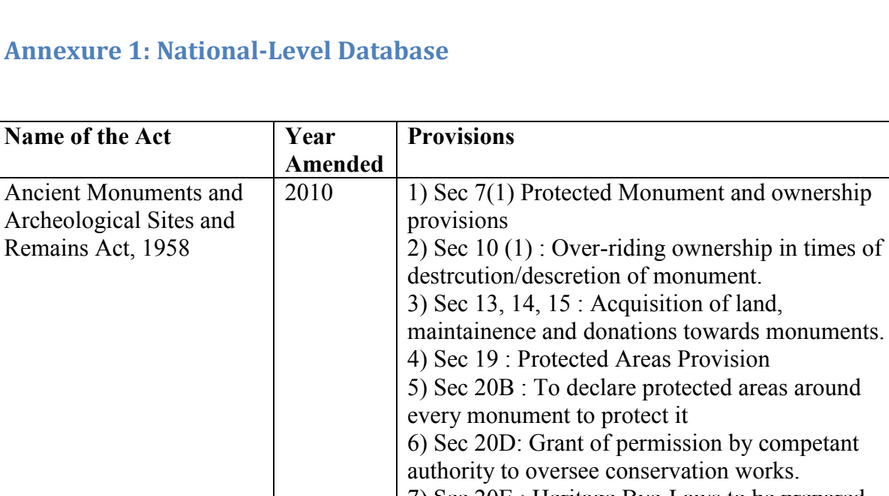
- Most of the Acts regarding heritage conservation or protection were primarily drafted in the British Era with few amendments post Independence and in the last decade.
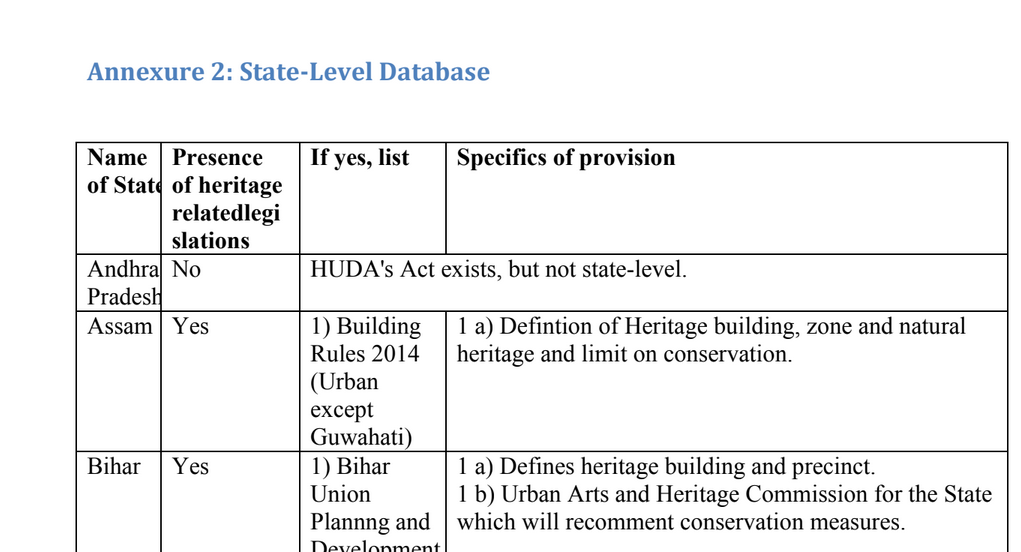
- 17 out of the 24 states studied have some sort of heritage regulation framework in place. Some of the states have specific heritage related schemes/regulations in place that are capable of providing protection to built heritage in particular.
- 49 cities had legislations regarding heritage conservation.
Impact and Recommendations
- Policy Recommendations:
Based on the research, I recommended the following interventions:- An evaluative index based on social and economic indicators would help assess impact of the guidelines.
- Assessing the progress of the HRIDAY scheme would help establish impact of policy guidelines.
- An integrated authority for heritage ought to be established at each of the levels specified with a uniform set of laws binding heritage conservation.
- Impact:
A report was submitted with the tri-systemic database created in partial fulfilment of fellowship requirements.
Visual Artifacts
Conclusion:
This project was a learning experience to understand how to propose, design, and conduct qualitative research.